
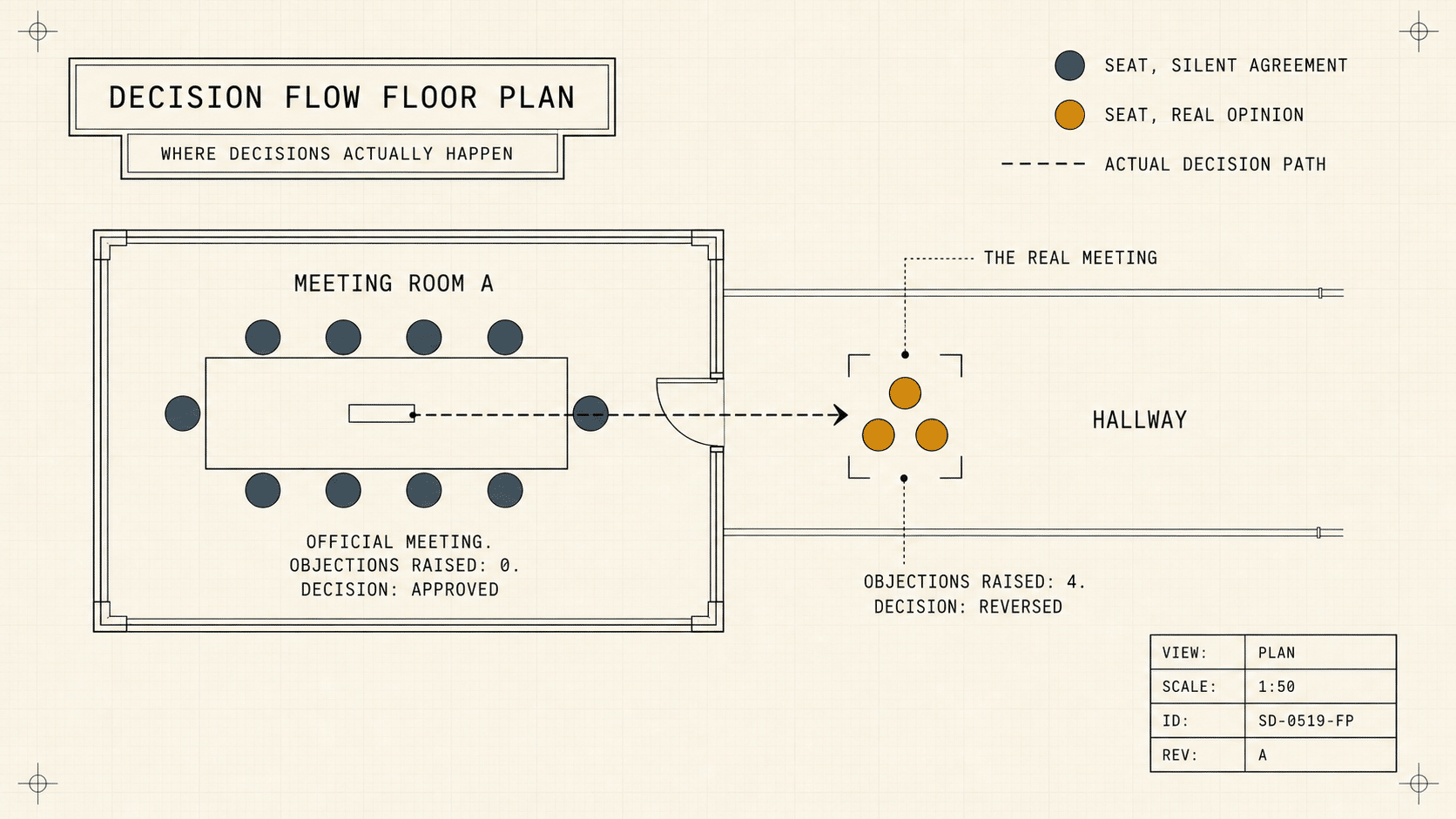
The meeting ends. Everyone agreed, or at least nobody disagreed. Then, two minutes later, the real conversation starts. In the corridor. In a side chat. In the small group that lingers after the call drops.
“I didn’t want to derail it.”
“I had concerns, but it wasn’t the moment.”
“Yeah, none of us actually bought that.”
The decision got made in a room that had all the information except the part that mattered.
If that happens on your team, it isn’t a sign people don’t care. It’s a sign they’ve done the math. Saying the hard thing in the room, to the person who owns the decision, costs something. Looking difficult. Slowing the meeting. Contradicting someone senior. And on a lot of teams, the quiet cost of staying silent feels smaller than the visible cost of speaking up. So the truth waits for a safer room.
What it costs
You make decisions on incomplete information and don’t find out until later, when the concern that lived in the hallway becomes the problem in production. You spend weeks executing a plan half the team quietly doubted. And the longer it goes, the more the hallway becomes the place where real work gets discussed, which means your actual meetings get emptier of everything that matters.
Why “speak up more” doesn’t work
The usual fix is to tell people to be braver. Encourage candor. Put “we value open feedback” on a slide. It doesn’t move anything, because you can’t exhort your way out of a cost. As long as saying the hard thing is more dangerous than swallowing it, people will keep swallowing it, and they’re not wrong to.
The thing that changes it isn’t courage. It’s changing what candor costs. Making it safe, and normal, and occasionally rewarded, to say the uncomfortable true thing to someone’s face.
The pattern, named
This is a Friction Signal, and it points at a fundamental most teams never fully built: it’s safe to tell each other the truth, including the truth that’s inconvenient, without it costing you. It’s one of the eight that decide whether any way of working actually delivers, whatever sits on top of it.
That’s what the Fundamentals First Repair System is built to find. The friction you feel traces to a specific, repairable behavior underneath. Repair it, and the hallway conversation moves back into the room, where it can actually change the decision.
So before your next big call, one thing to notice: where does the real conversation happen on your team? If the answer is “afterward, somewhere else,” you already know which fundamental is under pressure.
The Field Guide page on Trust and Candor covers that fundamental in full: what it means, the ways it fails, and the repairs worth trying.
It takes about a minute, and points you at the fundamental to look at first.