
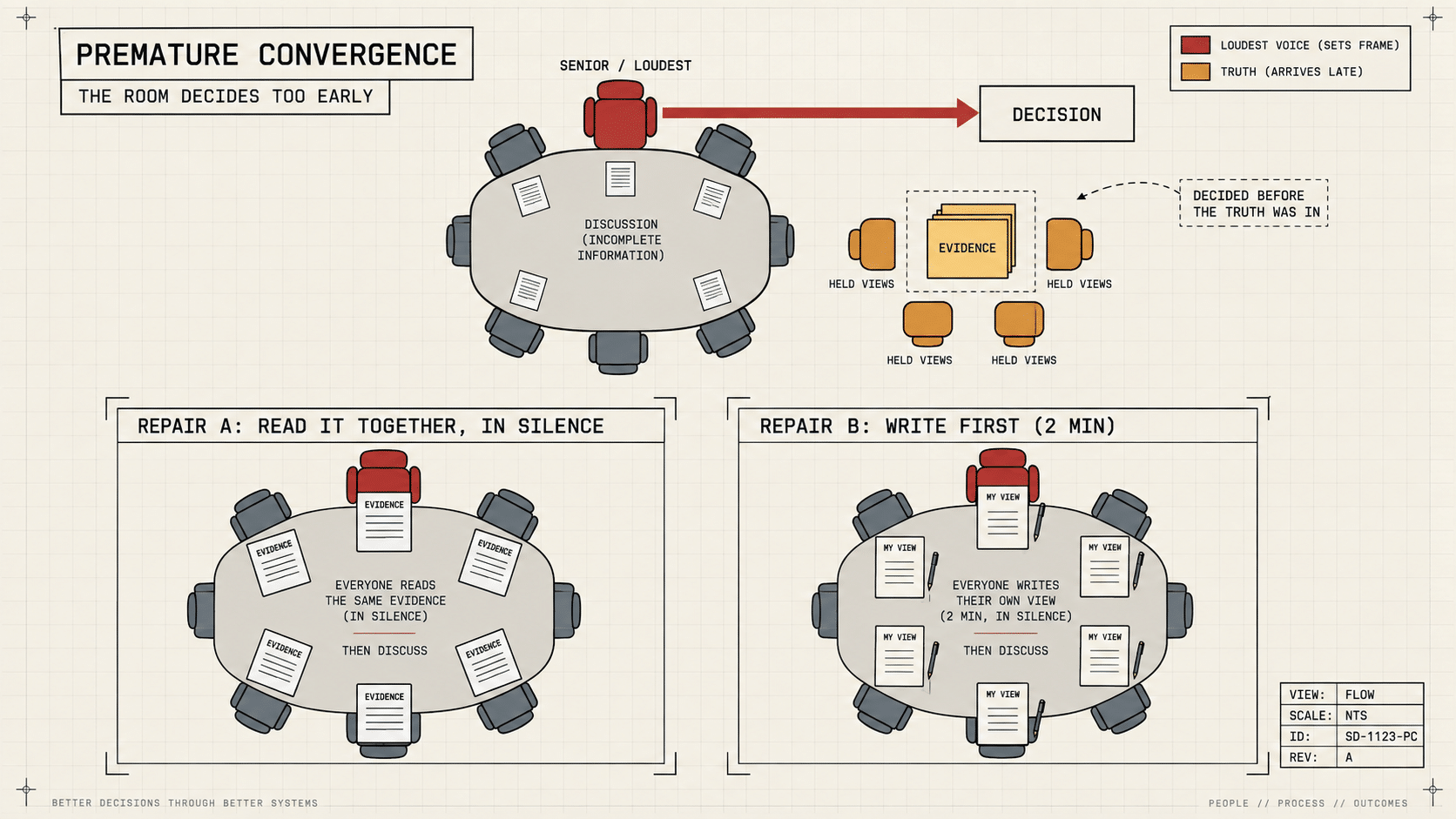
You know this meeting. The data is right there on the screen. Then the most senior person in the room says what they think, and the decision quietly bends to match, evidence or no evidence. Or it’s the other version: someone frames the question in the first thirty seconds, a couple of people nod, and the room “agrees,” while three people who saw it differently decide this isn’t the moment to say so.
Either way, the decision got made before the truth was even in the room. Not because anyone was careless. Because most meetings converge on the loudest or most senior voice long before the real information has a chance to land.
Someone wrote down that the database choice had quietly stopped being the team’s. The policy still said it was theirs. A business architect was making the call, and it was not their call to make. Nobody was going to say that out loud. At a niche insurer, two minutes of writing before anyone spoke started the argument that ended with the team choosing the database themselves, on the merits.
There are two small repairs for this, and they target two different reasons it happens. Neither is a culture program. Both fit inside a meeting you’re already having.
Two ways the room decides too early
The first reason is that the evidence is in the room and nobody has actually read it. The dashboard is open in a tab. The report went round on Friday. What gets discussed is everyone’s impression of it, and the most confident impression wins. This is a failure of Honest Inspection, the team looking at the real state of the work and naming it truthfully. And the comfortable version has a documented lean: status reporting drifts optimistic, because marking something red triggers escalation while leaving it green costs nothing today. That’s where a room drifts unless something anchors it to what can be shown. PMI’s 2024 Project Success research puts a price on the drift: projects with risk monitoring scored 41 on PMI’s success measure, against 14 for the ones without it. That is evidence that keeping an honest picture in front of the decision changes outcomes. It says nothing about whether a silent read is the way to get one.
The second reason is that hierarchy suppresses independent voice. People have the dissenting thought and keep it, because saying it in front of senior people feels more costly than staying quiet. This is a failure of Trust and Candor. And it’s the majority behavior, not the exception: in a 2025 Visier survey, about 46% of employees admitted they withhold honest feedback at work. That is people owning up to it in a survey, so treat it as the floor rather than the number. The real position exists. It just waits for the hallway.
Repair one: read the evidence together, in silence
Aim this at the room where the evidence is present and nobody has read it.
Before anyone says what they think, the team reads it together, in silence. The test results, the customer signals, the outcome numbers, whatever the decision actually rests on. Nobody speaks until everyone has looked up. Your own view goes last, after theirs.
Why it could help: the number already exists, it just has no route into the discussion until reading it is the first thing that happens in the room. Reading evidence as a group is a habit almost nobody has built, so it sits open in a tab while the conversation runs on what people remember of it.
A possible sign it’s working: people quote the thing they’ve just read rather than their memory of it, and the tab stops being opened and abandoned.
The watch-out is specific, and it’s the version most teams land on by accident: this turns into one person presenting the evidence to everyone else, and now the room is processing a speaker again. Reading together means each person reading it themselves. Not one person reading it aloud.
Repair two: write before you talk
Aim this at the room that goes quiet and calls it agreement.
On anything contested, everyone writes their own view privately for two minutes before the discussion opens, and then the writing gets shared. You write yours at the same time and put it in the same batch, so nobody has to go first.
Why it could help: speaking up in front of the person who decides your next raise carries a risk, and staying quiet carries none. The people with the least standing in the room work that out early, which is why inviting them to speak up leaves the risk exactly where it was. Writing first puts every view on the table before rank has filtered any of them.
A possible sign it’s working: positions appear that would not have survived being said second, and at least once a quiet person’s note changes a decision that looked settled. The watch-out: writing is the first thing dropped when time is short, which is exactly when the pressure to converge is strongest, and if it only ever runs on the easy topics then the hard ones are still being decided the old way.
Why bother, in one number
Because the quiet room is not the safe room. When Google studied 180 of its own teams in Project Aristotle, the strongest predictor of performance wasn’t talent or resources. It was whether people felt safe to say the hard thing. A meeting that decides before the truth is in isn’t efficient. It’s expensive, you just pay for it later, when the thing everyone privately doubted turns out to be exactly the problem.
So pick the version you recognize. If the evidence keeps getting acknowledged and then ignored, try reading it together. If the real disagreement keeps showing up after the meeting, try writing first. Then watch what changes.
The Field Guide covers both of these in full, Honest Inspection and Trust and Candor: what each one means, how it fails, and the repairs worth trying.
Your framework isn’t broken. Your fundamentals are.