
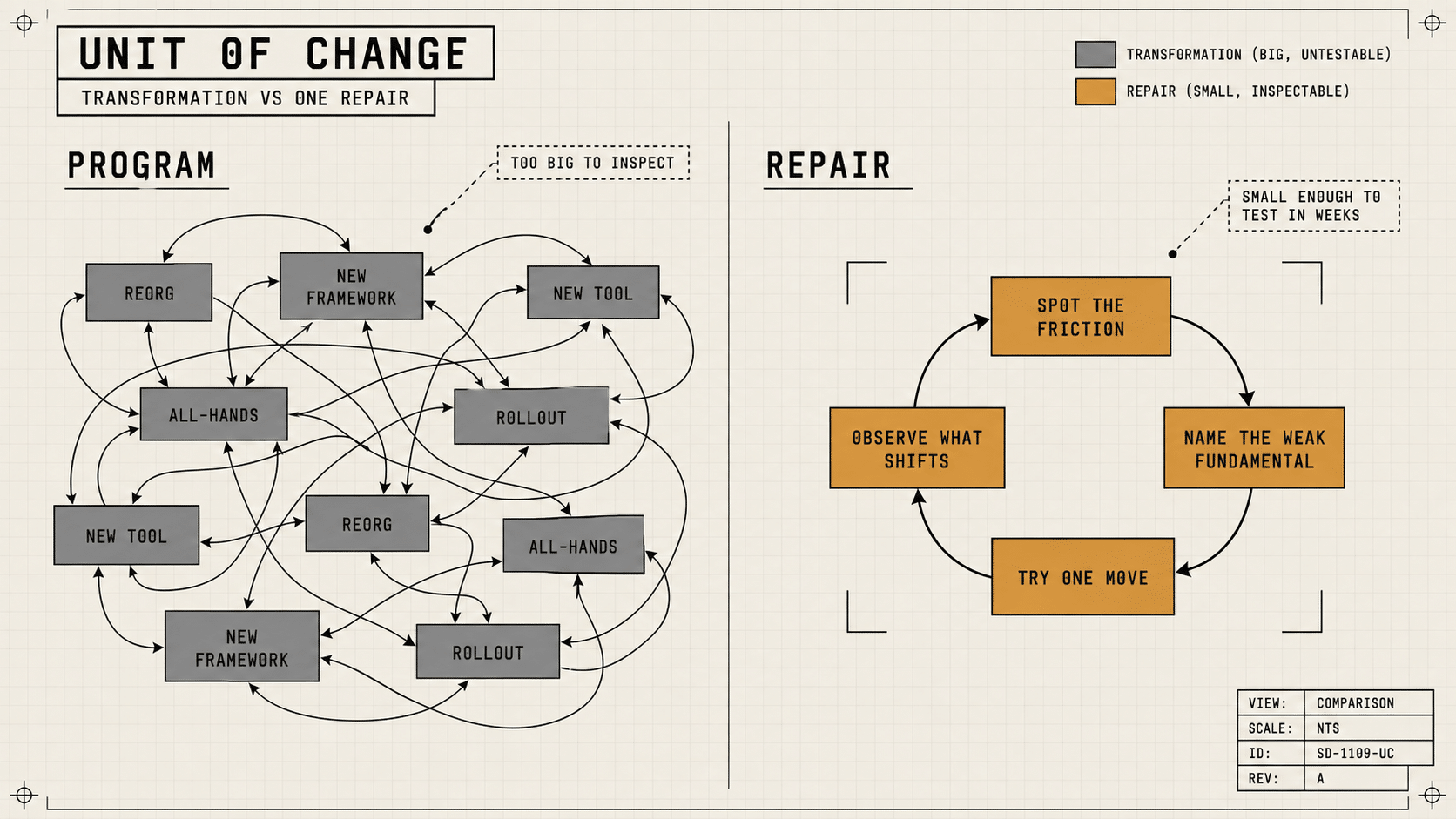
You’ve done the big change. Maybe more than once. The reorg, the new framework, the tooling migration, the all-hands where someone put “cultural change” on a slide. Months of disruption, a real budget, everybody’s attention.
And here you are, hitting the same frictions you started with. The status that stays green until it snaps. The retro that changes nothing. The team that waits more than it works.
That isn’t bad luck, and it isn’t because you picked the wrong framework this time. It’s because the unit of change was always too big. A transformation tries to change everything at once, which means it can’t isolate what actually made the difference, can’t be inspected while it’s happening, and can’t be undone when a piece of it makes things worse. You find out if it worked a year later, when it’s too late and too expensive to matter.
There’s a smaller unit that actually moves. One repair at a time.
Why the big change keeps missing
The gap the transformation is supposed to close is real. In Digital.ai’s 2025 State of Agile report, 55% of organizations said they had complete visibility into what was being developed, while 63% said they struggled to deliver reliable, high-quality software. More process, more oversight, and the delivery problem is still there. That’s the tell: the thing that’s weak isn’t the framework. It’s a behavior underneath it that no rollout installs.
So instead of installing another process, you repair the fundamental underneath the friction. Not all eight fundamentals, not the whole team, not this quarter. One friction, one fundamental, one small move you can watch.
The loop
The whole system runs on four steps. It’s small enough to run this week.
- Spot the Friction Signal. Start from what the team actually feels, the pattern people recognize instantly. Not a complaint, not a diagnosis. “We keep getting surprised.” “The real meeting happens in the hallway.”
- Name the weak fundamental. A friction tells you where to look. A few honest questions tell you what you’re looking at, the fundamental most likely under pressure. Usually more than one, which is fine.
- Try one Repair Move. A small, testable change you can run in a few weeks and actually inspect. Not a transformation. One thing.
- Observe what shifts. Then you watch, honestly. Did anything change? If nothing surfaced, the move didn’t take, and that’s information too.
That’s it. Spot, name, try, observe. Then go around again.
The part that makes it honest
Two things keep this from becoming just another framework.
First, a friction almost never has a single cause with a single fix. The loop points you at the fundamental most likely under pressure and hands you a repair to try, not the answer. You run it as an experiment and let what shifts tell you whether you aimed right.
Second, the reason a fundamental eroded almost always sits in the system around the team, not in the team’s willpower. “Just be more transparent” is useless advice when roughly 6 in 10 employees say they’re afraid to speak up at work, as a 2026 Radical Candor survey found. You don’t fix that with a poster. You change what surfacing a problem costs, one small move at a time, and you watch whether the truth starts arriving earlier.
Small enough to actually do
A transformation asks you to bet a year on a change you can’t inspect. A repair asks you to bet two weeks on a change you can. If it works, you feel it fast and you keep going. If it doesn’t, you’ve lost two weeks and learned something specific. That asymmetry is the whole argument.
So the next move isn’t a program. It’s picking the one friction your team feels most, and the fundamental most likely under it. That takes about two minutes to find.
The Field Guide takes all eight fundamentals one at a time, with what each one means, how it fails, and the repairs that address it. It is free and there is nothing to sign up for.
Your framework isn’t broken. Your fundamentals are.