
The demo works. The feature does exactly what the slide said it would. Someone says “nice.” A couple of people do the little typing-clap in the chat. “Any questions?” A pause, the good kind, the kind that means we’re done. “Great, thanks everyone.”
And the review is over.
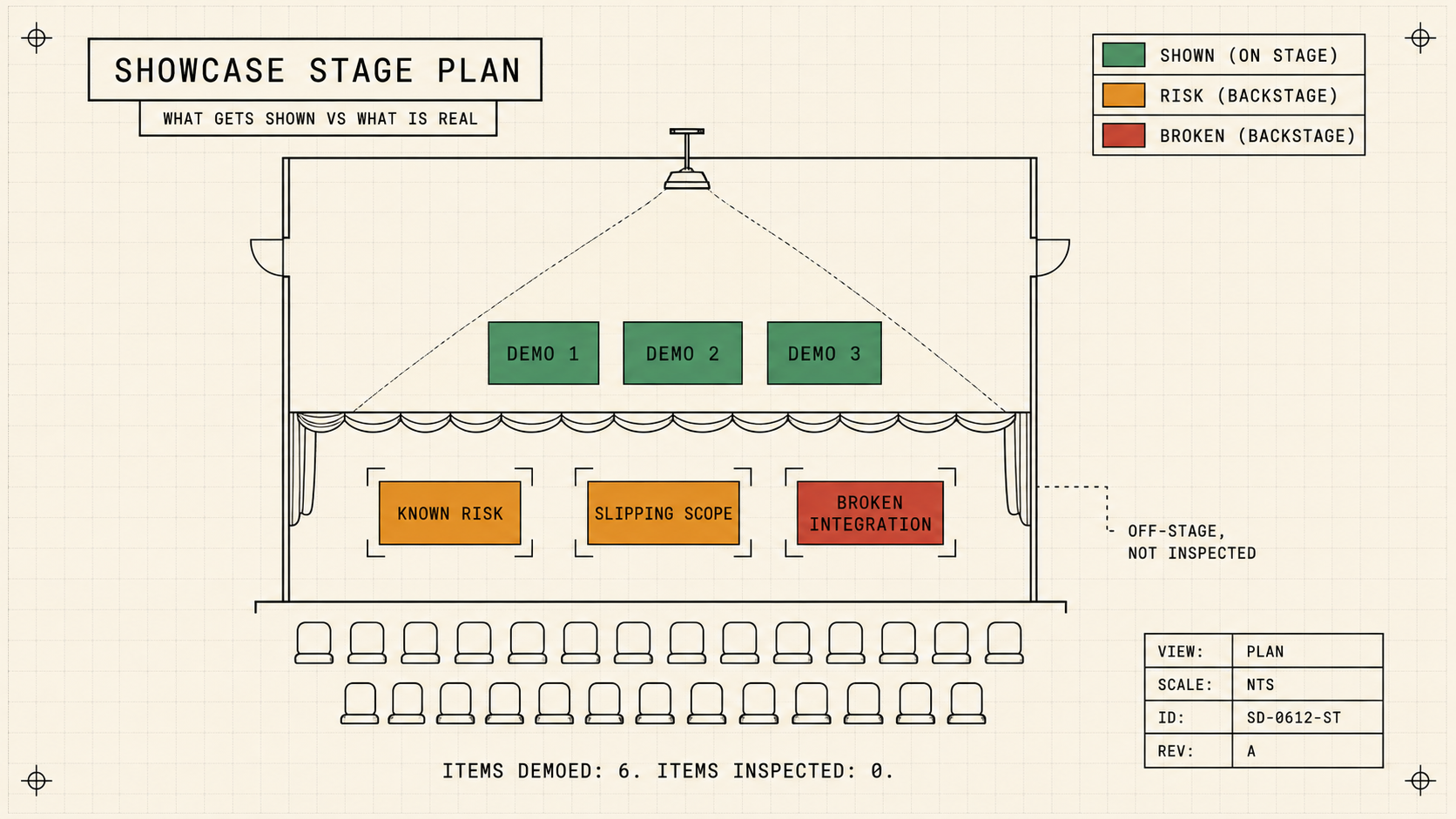
Notice what didn’t happen. Nobody looked at the thing that’s three weeks behind. Nobody mentioned the integration that’s holding together with tape. The risk everyone’s privately worried about didn’t come up, because this wasn’t the room for it. Something was shown. Nothing was inspected.
That’s the quiet swap at the heart of most reviews. Showing replaced inspecting, and nobody noticed, because showing feels productive and looks like progress. You leave the meeting a little reassured, which is exactly the problem: the meeting that’s supposed to surface the real state of the work has become the meeting most engineered to hide it.
Showing is not inspecting
Here’s the distinction the calendar invite blurs. Showing is presenting the parts you chose, in the light you chose, to people you’d rather impress than alarm. Inspecting is holding the whole thing up to the light, including the parts you’d never put on screen, and asking what’s actually true.
A review that only shows the wins is a highlight reel. It’s the most watchable meeting of the Sprint and the least honest one.
And this isn’t a Scrum problem. Call it a Sprint Review, a demo, a showcase, a stage-gate, a monthly steering update. Every way of working has a moment where the team is meant to look squarely at the real state of the work. The name changes. The theatre is the same.
Why the highlight reel wins by default
Nobody decides to fake it. The reel wins because of gravity. Showing the polished thing is safe; showing the broken thing invites questions you can’t fully answer yet. So the demo drifts toward what’s finished, the status drifts toward green, and the honest picture, the one with the risk and the slipping scope in it, waits for a smaller, safer room. It’s the consistent finding in project-reporting research: when a status is wrong, it’s wrong in the optimistic direction far more often than not.
Over a few Sprints, the team stops even seeing it. The gap between “what we show” and “what’s real” becomes the normal way the review runs, and a normal you’ve stopped noticing is the hardest kind to fix.
How to tell a review from a reel
Four signs the meeting is theatre, not inspection:
- Only finished, working things make it onto the screen. The half-built, the fragile, and the known-broken stay off-stage.
- No decision changes because of the review. Everyone leaves with the plan they walked in with.
- The real conversation happens afterward, in a smaller room, or not at all.
- Stakeholders attend, nod, and slowly stop showing up, because nothing there ever surprises them.
If you recognized three of those, the missing piece isn’t a better agenda or a livelier facilitator. It’s a fundamental: Honest Inspection, the team looking at the real state of its work, quality and risk included, and naming it truthfully, especially when it’s bad. No ceremony installs that. You either do it or you perform around it.
One change, next review
Before you show a single thing that works, show one thing that doesn’t, and one risk you’re genuinely worried about. Put the least-finished, most-uncertain item first, while there’s still time to act on it. It will feel wrong, and the room will go quiet, and that quiet is the first honest thing the review has produced in months.
You’ll know it worked when a review changes what the team does next, instead of just confirming what it was already going to do.
So, one question to take into your next one: when did a review last change a decision on your team? If you can’t remember, you already know which fundamental is under pressure.
The Field Guide page on Honest Inspection covers that fundamental in full: what it means, the ways it fails, and the repairs worth trying.
Your Scrum isn’t broken. Your fundamentals are.