
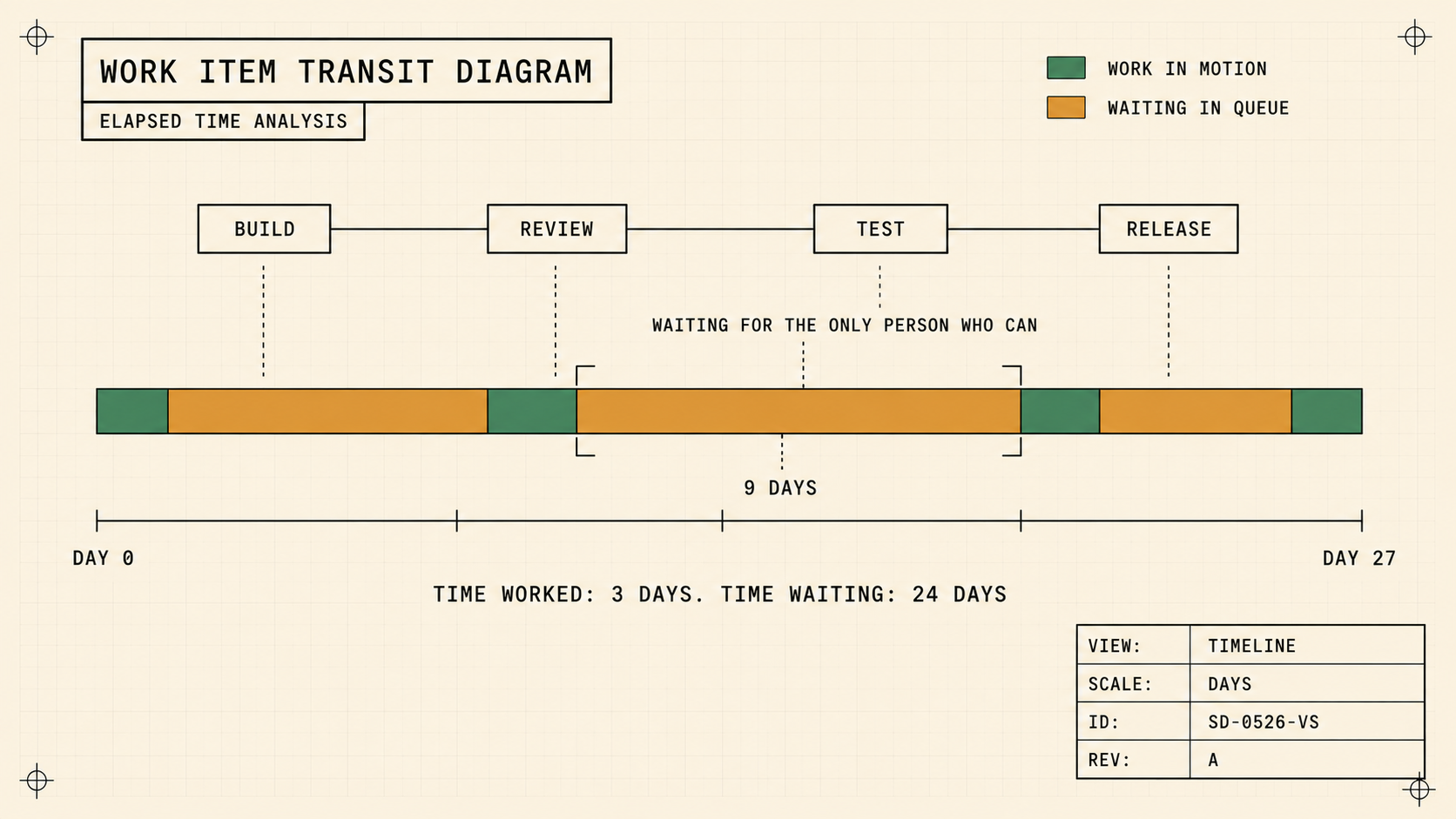
Watch where the work actually spends its time. Not the hours someone is heads-down building. The days it sits, waiting. Waiting for the one person who knows that system. Waiting for the other team to finish their sprint. Waiting for a review, a sign-off, an environment, an answer from someone who’s out until Thursday.
Add up the building time and it’s small. Add up the waiting and it’s most of the calendar.
That’s the thing about a slow team. Usually it isn’t slow. The people are working hard and well. The work is just passing hand to hand, stalling a little in every gap between one specialty and the next, and those gaps are where your weeks go.
What it costs
You can’t commit to a date, because the date depends on a handoff you don’t control. You can’t compress the timeline by adding effort, because the bottleneck isn’t effort, it’s the wait. And your whole delivery pace gets set by the slowest boundary in the chain, no matter how fast anyone works inside it. Meanwhile “we’re blocked on another team” becomes the most common line in your status updates, and nobody feels like it’s theirs to fix, because on their own, it genuinely isn’t.
Why reorganizing doesn’t fix it
The instinct is to redraw the boundaries. New team structure, new ownership lines, a reshuffle so the dependencies land differently. It helps for a while, then the same pattern reappears in new shapes, because you moved the boundaries without closing the gap. The handoffs that stalled the work are still handoffs. They just run between different boxes now.
The real question isn’t how to arrange the specialists. It’s whether a team can carry a piece of work far enough on its own to stop waiting on someone outside it for every step.
The pattern, named
This is a Friction Signal, and it points at a fundamental most teams never fully built: the team has enough of the skills it needs to deliver without a handoff for every move. It’s one of the eight that decide whether any way of working actually delivers, whatever framework runs on top.
That’s what the Fundamentals First Repair System is for. The friction you feel traces to a specific, repairable behavior underneath. One more friction to sit with, then we start naming the fundamentals themselves, one at a time, and showing what to actually do about each.
So one thing to look at this week: how much of your team’s calendar is building, and how much is waiting? If waiting wins, you already know where the fundamental is weak.
The Field Guide page on Skill Completeness covers that fundamental in full: what it means, the ways it fails, and the repairs worth trying.
About a minute, and it points you at the fundamental to look at first.