
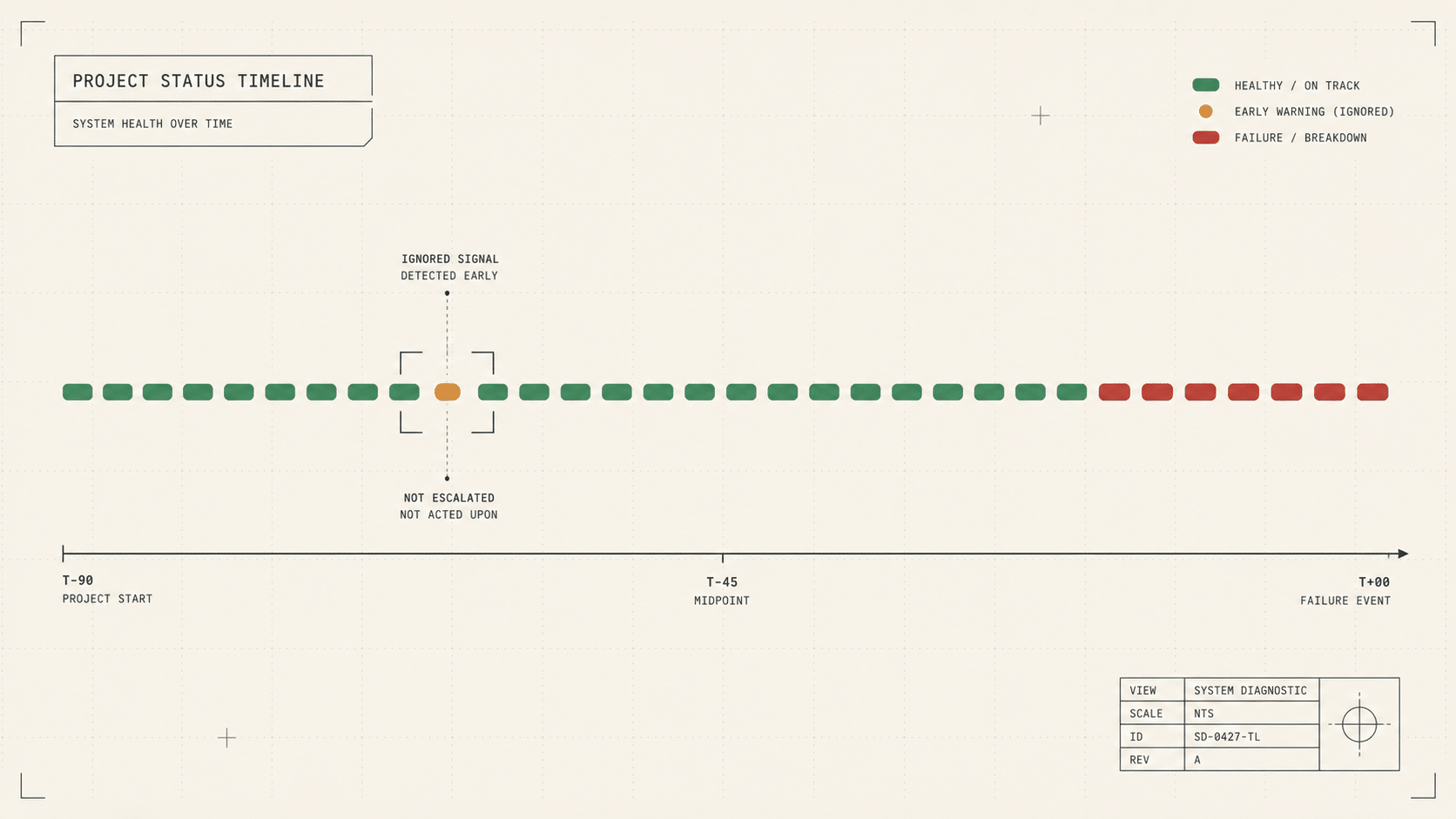
The status was green all quarter. Green in the weekly report, green in the steering deck, green in the note to the sponsor. Then, close to the deadline, it went red. Not drifted. Snapped.
And in the post-mortem, the part that stings: one after another, people say they already knew.
“I had a bad feeling about that integration.”
“The estimates never felt real.”
“I figured someone else would raise it.”
The information was in the building the whole time. It just never made it into a decision while there was still time to act on it.
If you’ve lived that, you’ve met one of the most common frictions there is. It surprises everyone at the top and no one at the bottom. The truth existed. It arrived too late to matter.
And notice what didn’t cause it. Not the framework. Not the tooling. Not the event you did or didn’t run. You can do all of that by the book and still get blindsided, because this lives underneath all of it.
What it actually costs
The missed date is the smallest part. The real bill is the scramble that follows: your best people pulled onto a fire that a two-line message could have put out a month earlier. And then the slower, quieter cost, the sponsor who stops trusting green. Now every report gets second-guessed and every team gets asked for more detail, which slows everyone down. After that, every green report gets a little less believable.
Why “just speak up sooner” never works
Most post-mortems end here, with “we need better communication” or “people should raise concerns earlier.” That treats a structural problem as a personal one, and it fixes nothing.
Your people aren’t careless. Most of them did the very human thing: they saw a risk, weighed what it would cost to raise it before they were sure, and decided the cost was too high. Speaking up early means sticking your neck out on a maybe, in front of people whose opinion of you matters. On a lot of teams, that’s a bad trade. So the concern gets polished into something safer, or it waits until it’s undeniable, which is exactly when it stops being useful.
Change what it costs to bring bad news early, and the surprises stop. Leave that cost in place, and no amount of “be more transparent” will move it.
The pattern has a name, and so does the cure
What you’re looking at is a Friction Signal: a specific, recognizable pattern that points to a specific behavior underneath it. This one points to a behavior most teams never fully built, reality arriving early, while a problem is still small enough to act on. It’s one of eight fundamentals that decide whether any way of working actually delivers, whatever framework sits on top.
That’s the whole idea behind the Fundamentals First Repair System. The friction your team feels is the visible end of something specific and repairable. Find it, and you stop managing surprises and start preventing them.
Naming this fundamental, and the one small move that rebuilds it, is where this series goes next. For now, one question to take into your next review: on your team, how long does a weak signal sit before it changes a decision? If the honest answer is “until it’s a crisis,” you already know something is under pressure.
You can find out which fundamental in about a minute.
The Field Guide page on Reality Transparency covers that fundamental in full: what it means, the ways it fails, and the repairs worth trying.
Next in this series: what that fundamental is, and why more process never fixes it.