
In Digital.ai’s 2025 State of Agile, 55% of organizations said they have complete visibility into what they’re building. In the same survey, 63% can’t reliably deliver it, up 12 points in a year. Those two findings describe the same companies.
Sit with that. Visibility went up. Delivery got worse. If visibility were the thing that saved you, that graph would slope the other way.
A few weeks ago we looked at the surprise everyone saw coming: the status that was green all quarter and then snapped, and the post-mortem where person after person admitted they’d already known. The strange part of that story was never that the information was missing. It was there. It was on a board, in a thread, in someone’s head. The information was in the building the whole time.
So why did it still surprise everyone at the top? Because seeing the work and understanding it the same way are two completely different things, and almost everyone treats them as one.
Visibility is not transparency
Visibility is the data being somewhere you could look. A dashboard exists. A board is up to date. The number is on a screen.
Transparency is different. Transparency is everyone holding the same accurate picture of the real state of the work, its progress, its quality, its risk. It’s shared understanding, not shared access.
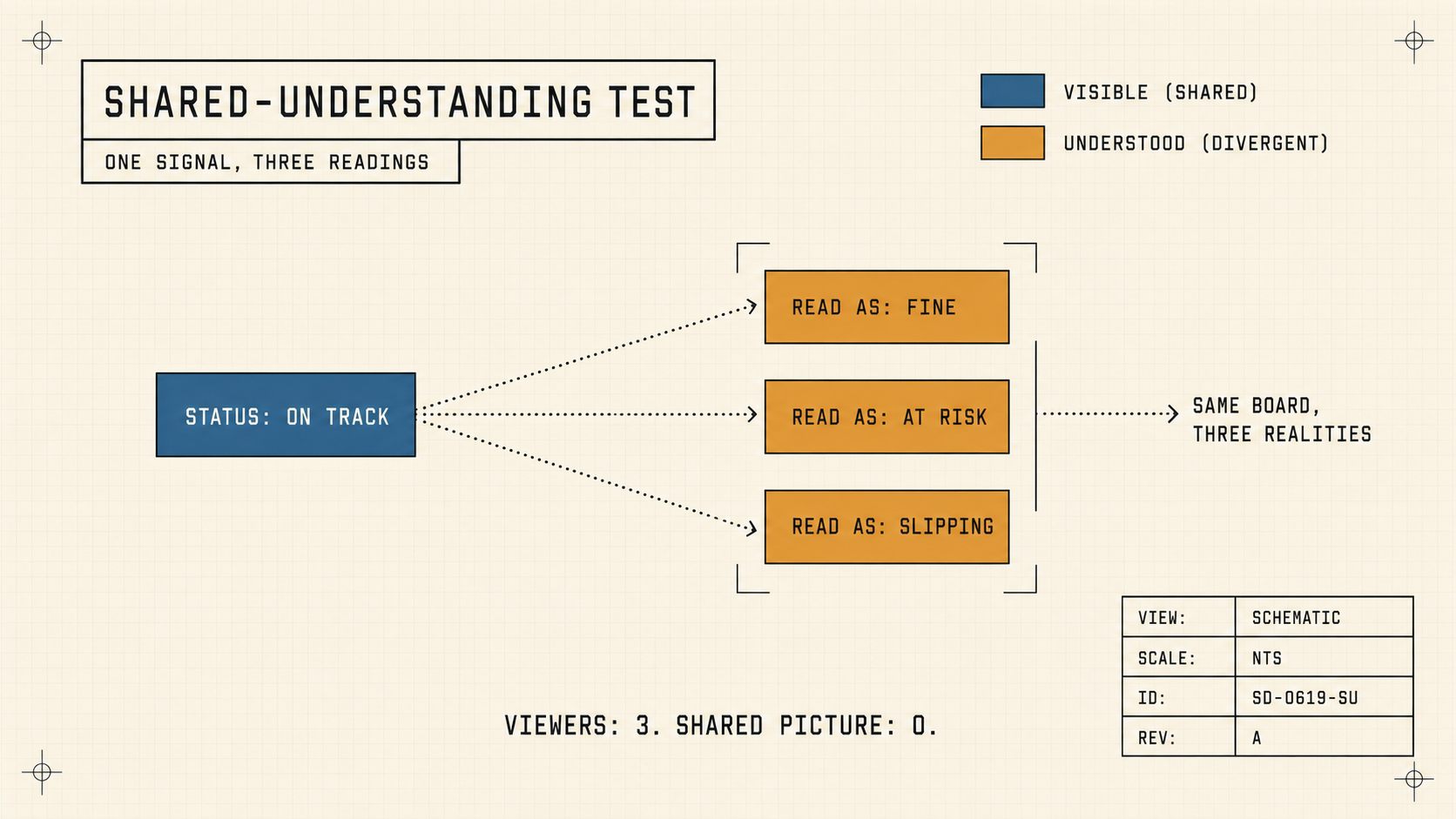
You can have total visibility and near-zero transparency, and most teams do. Everyone can open the board. “On track” sits there in green. To one person that means “we’ll make the date.” To another it means “nothing’s on fire, probably.” To the person doing the work it means “on track if three things I’m worried about go right.” One label. Three realities. Nobody’s lying, and nobody shares the same picture.
That’s the dashboard mirage: the more screens you add, the more everyone feels informed, and the less anyone actually shares the real state. And it isn’t only a team-level thing. Leaders consistently rate their own internal communications far higher than their people do, a gap of about 30 points on whether the message was even clear (Axios HQ, 2025). The person sending the signal and the person receiving it are looking at two different realities and both think they’re aligned.
How to tell visibility from transparency
Four signs you have the first and not the second:
- The same status means different things to different people, and nobody has noticed.
- Everyone has access to the data, but no one can tell you the real state of the important thing without calling a meeting.
- The people closest to the work and the people deciding about it are holding visibly different pictures of the same project.
- A problem sat visible on some board for weeks before anyone acted on it.
If those feel familiar, the fix is not another tool. Another dashboard adds visibility, which you already have too much of. What’s missing is a fundamental: Reality Transparency, everyone understanding the real state of the work the same way. Tools can show the data. Only the team can share the understanding.
One change, this week
Pick the most important thing your team has in flight. Ask three people, separately, to describe its real state in one sentence. Don’t prompt them, don’t let them confer.
If you get three different answers, and you probably will, you’ve just found the exact gap between what’s visible and what’s understood. That gap is where your next surprise is already forming. Close it by making the team agree, out loud, on what the real state is and what “on track” would actually have to mean, in terms you could observe.
You’ll know it’s working when the status on the board and the status in people’s heads are the same status.
So, one question before your next review: could three people on your team, asked separately, describe your most important work the same way?
The Field Guide page on Reality Transparency covers that fundamental in full: what it means, the ways it fails, and the repairs worth trying.
Your framework isn’t broken. Your fundamentals are.